
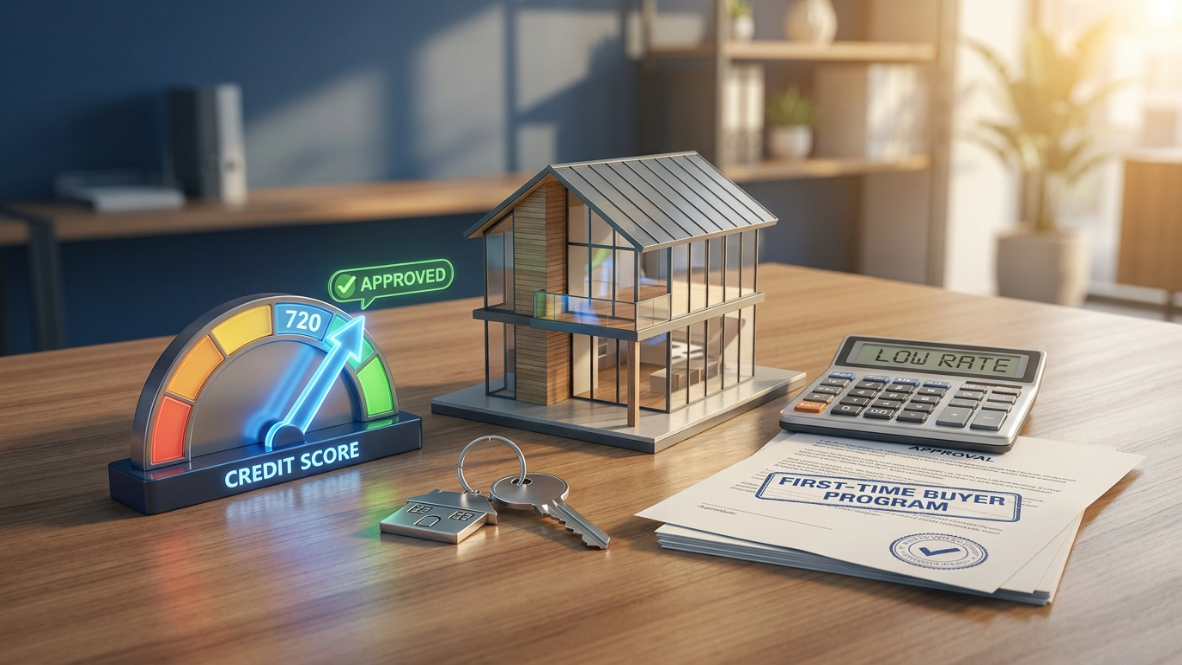
Buying your first home with a less-than-perfect credit score can feel like an uphill battle. High inflation, shifting central bank interest rates, and strict underwriting guidelines in Tier-1 markets (USA, UK, Canada, Australia) have made traditional borrowing tighter. However, having a fair or low credit score does not disqualify you from homeownership.
Ultimate Personal Loan Guide 2026: Compare Rates & Apply Smart
Governments and specialized financial institutions offer dedicated First-Time Home Buyer (FTHB) programs engineered specifically for low-to-moderate-income applicants and borrowers rebuilding their credit history.
This master guide explores the top low-credit mortgage programs, eligibility requirements, down payment assistance options, and actionable steps to secure home financing.
1. Top Government-Backed Low Credit Mortgage Programs
Government-backed loans are insured against default, allowing lenders to offer significantly lower credit score thresholds and smaller down payment requirements compared to conventional loans.
                  [ GOVERNMENT-BACKED LOAN OPTIONS ]

      FHA LOAN                     VA LOAN                    USDA LOAN
+-------------------+        +-------------------+       +-------------------+
| Min Credit: 500   |        | Min Credit: None* |       | Min Credit: 640*  |
| Down Pay: 3.5%    |        | Down Pay: 0%      |       | Down Pay: 0%      |
| Government Insured|        | Veterans/Military |       | Rural Properties  |
+-------------------+        +-------------------+       +-------------------+
A. FHA Loans (Federal Housing Administration)
The FHA loan remains the gold standard for first-time home buyers with low credit scores in the United States.
- Minimum Credit Score: 580 for a 3.5% down payment; 500–579 for a 10% down payment.
- Key Advantage: Underwriters evaluate manual compensating factors (e.g., strong rent payment history or steady cash flow) rather than relying strictly on automated credit scoring.
- Mortgage Insurance: Requires an Upfront Mortgage Insurance Premium (UMIP) of 1.75% plus an Annual Mutual Mortgage Insurance (MMI) paid monthly.
B. VA Loans (U.S. Department of Veterans Affairs)
Exclusive to eligible military service members, veterans, and surviving spouses.
- Minimum Credit Score: No official government floor (most lenders look for 580–620).
- Key Advantage: 0% down payment required and no ongoing private mortgage insurance (PMI).
- Funding Fee: A one-time funding fee applies, which can be rolled directly into the total loan balance.
C. USDA Loans (U.S. Department of Agriculture)
Designed to encourage homeownership in designated rural and suburban communities.
- Minimum Credit Score: Typically 640 for automated processing; lower scores require manual underwriting.
- Key Advantage: 0% down payment required.
- Income Caps: Applicants must meet local household income limits (generally capped at 115% of the area median income).
2. Conventional Options for Lower Credit Tiers
While conventional loans are backed by private entities (like Fannie Mae and Freddie Mac), specialized 3%-down programs exist for low-income and first-time buyers:
HomeReady® (Fannie Mae) & Home Possible® (Freddie Mac)
- Minimum Credit Score: 620.
- Down Payment: As low as 3%.
- Key Feature: Allows income contributions from non-occupant co-signers or boarders to help meet Debt-to-Income (DTI) requirements. Reduced private mortgage insurance (PMI) rates apply once you reach 20% home equity.
3. Comparison Matrix: Low-Credit Loan Options
| Loan Program | Min. Credit Score | Min. Down Payment | PMI / Insurance Requirement | Best For |
| FHA Loan | 500 (10% down) / 580 (3.5% down) | 3.5% | Mandatory lifetime MIP (for <10% down) | Borrowers with past credit issues & low cash reserves |
| VA Loan | 580 – 620 (Lender specific) | 0% | No PMI (One-time funding fee) | Veterans, active-duty military, and military spouses |
| USDA Loan | 640 (Automated) | 0% | Low annual guarantee fee | Buyers in eligible rural/suburban regions |
| HomeReady® | 620 | 3% | Reduced cancelable PMI | Low-to-moderate-income buyers with fair credit |
4. Down Payment Assistance (DPA) Grants & Second Loans
One of the biggest obstacles for low-credit buyers is saving for upfront costs. Down Payment Assistance (DPA) programs—administered by state and local housing finance agencies (HFAs)—can cover down payments and closing fees.
   [ State / Local HFA ] ➔ Grants (0% Repayment)
                         ➔ Forgivable Soft Seconds (Forgiven after 3–5 years)
                         ➔ Deferred Payment Low-Interest Loans
- DPA Grants: Direct financial aid that does not require repayment as long as you stay in the home for a specified period.
- Forgivable Soft-Second Loans: A second mortgage provided at 0% interest, which is fully forgiven if you live in the property as your primary residence for a set duration (typically 3 to 10 years).
- Matched Savings (IDA Programs): Individual Development Accounts (IDAs) offer low-income buyers matching dollars (e.g., $2 to $3 for every $1 saved) toward a home purchase.
5. Compensating Factors: How to Pass Manual Underwriting
When your credit score falls below automated approval thresholds, human underwriters review your application manually. You can compensate for a lower credit score by strengthening these areas:
                  [ COMPENSATING FACTORS TO STRENGTHEN ]

   +--------------------------+       +--------------------------+
   |  Low Debt-to-Income      |       |  Verification of Rent    |
   |  (DTI under 31/43%)      |       |  (12-month on-time trend)|
   +--------------------------+       +--------------------------+
                 │                                 │
                 └──────────────┬──────────────────┘
                                ▼
   +--------------------------+       +--------------------------+
   |  Liquid Cash Reserves    |       |  Consistent Earnings     |
   |  (3–6 months PITI)       |       |  (2+ years same line)    |
   +--------------------------+       +--------------------------+
- Verification of Rent (VOR): Providing 12 to 24 consecutive months of bank statements proving on-time rent payments provides strong evidence of payment reliability.
- Low Debt-to-Income (DTI) Ratio: Keep your recurring debt payments below 31% for housing costs and 43% for total monthly debt obligations.
- Post-Closing Cash Reserves: Having 3 to 6 months of Principal, Interest, Taxes, and Insurance (PITI) stored in a liquid savings account drastically reduces perceived lender risk.
- Consistent Income History: Demonstrating 2+ years of steady or increasing earnings in the same industry signals stability.
6. Step-by-Step Action Plan to Qualify for a Mortgage
Step 1: Credit Audit ➔ Step 2: DTI Reduction ➔ Step 3: DPA Search ➔ Step 4: Pre-Approval
Step 1: Pull and Audit Your Credit Reports
Obtain free credit reports from the major bureaus (Equifax, Experian, TransUnion). Audit for inaccurate collection items, incorrect balances, or unauthorized accounts, and file disputes immediately.
Step 2: Optimize Your Revolving Debt
Pay down high-utilization credit cards. Lowering total utilization below 30% (and ideally below 10%) can boost your credit score by 20–50 points within 30 to 60 days.
Step 3: Research Local State Housing Programs
Look up your local State Housing Finance Agency (HFA). Compare local first-time home buyer assistance offers and complete a mandatory homebuyer education course (often required for DPA eligibility).
Step 4: Seek Pre-Approval with an FHA/VA Manual Underwriting Lender
Not all mortgage brokers handle complex low-credit applications. Work with lenders who explicitly specialize in manual underwriting and government-backed home loans.
7. Frequently Asked Questions (FAQ)
Can I get a mortgage with a 500 credit score?
Yes. FHA guidelines permit approvals for credit scores between 500 and 579, provided you make a 10% down payment and satisfy manual underwriting criteria (such as no active delinquent federal debt).
Does applying for down payment assistance lower my credit score?
No, researching or enrolling in DPA programs does not hurt your score. However, when the lender formally pulls your credit for the underlying mortgage, a standard hard inquiry will occur.
Should I wait to repair my credit or buy now?
If your score is near a threshold (e.g., 560 vs. 580), spending 3 to 6 months paying off collections and lowering card balances can save you tens of thousands of dollars in interest and lower down payment requirements.
Disclaimer: Mortgage guidelines, interest rates, and government assistance thresholds vary by region, state, and individual financial profile. Always consult a licensed mortgage broker or certified housing counselor before signing loan agreements.

Md Badsha Alam is a content strategist and digital writer specializing in Personal Finance . With years of experience researching emerging industry trends and financial technologies, he crafts data-driven guides and in-depth analyses designed to help readers make informed decisions. When not writing, Md Badsha Alam tests digital tools and tracks industry developments.